%20(1)_20220516165429_0.png&w=256&q=75&dpl=dpl_C5SrfWafKwQk6mXqr4afJFfDde7S)
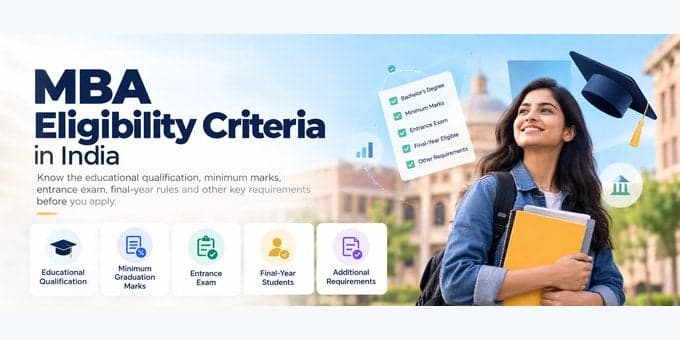
MBA eligibility criteria in India generally include a recognised bachelor's degree, the minimum graduation marks required by the institution, and any applicable entrance exam or selection requirements. Many MBA colleges accept graduates from different academic streams. However, minimum marks, category-specific provisions and final-year admission rules vary by institution.
Before applying, check these five requirements:
- Educational qualification: Does your bachelor's degree meet the institution's requirements?
- Graduation marks: Do you meet its minimum percentage or CGPA criteria?
- Entrance exam: Does the programme require CAT, CMAT or another accepted test?
- Final-year status: Can you apply before your graduation results are declared?
- Additional conditions: Are there programme-specific requirements, interviews or other selection rounds?
There is no single eligibility rule for every MBA college in India. Always consult the latest official admission notice for your intended intake.
MBA Eligibility Criteria in India: Quick Overview
| Eligibility Factor | What Applicants Need to Know |
|---|---|
| Educational qualification | A recognised bachelor's degree that meets the institution's admission rules |
| Minimum graduation marks | Set by the institution; 50% is a common threshold at some colleges, not a universal requirement |
| Academic stream | Many MBA programmes accept graduates from arts, commerce, science, engineering and other disciplines |
| Entrance exam | Depends on the college and programme |
| Final-year students | May be allowed to apply provisionally, subject to completion and document deadlines |
| Work experience | Not compulsory for every MBA; some programmes require or consider it |
| Age limit | Check the rules of the particular institution and programme |
| Selection process | May include entrance scores, interviews, academic records and other assessments |
This table provides general guidance. Meeting the basic eligibility criteria allows an applicant to be considered for admission; it does not guarantee a seat.
1. What Educational Qualification Is Required for an MBA?
A bachelor's degree from a recognised university or an institution accepted under the applicable admission rules is a standard requirement for MBA admission. The exact qualification requirements depend on the programme.
Can students from any academic stream pursue an MBA?
Many MBA programmes accept graduates from different academic backgrounds, including:
- BBA and BCom: Students may explore finance, marketing, human resources and general management.
- BTech and BE: Engineering graduates may consider operations, analytics, finance, marketing and general management.
- BA: Arts and humanities graduates can apply to MBA programs that accept their qualifications.
- BSc and BCA: Science and computer applications graduates may consider general management and other available specialisations.
These are examples of potential study pathways, not guarantees of admission to a particular specialisation. Applicants must satisfy the programme's published eligibility requirements.
For example, the official IIT Bombay SJMSOM MBA admission criteria for the 2026–28 batch state that the programme is open to graduates from all disciplines, subject to its specified qualification, marks and entrance exam requirements.
Can final-year students apply for an MBA?
Many institutions allow final-year undergraduate students or candidates awaiting results to apply provisionally. Applicants must generally complete their qualifying degree and satisfy the required academic criteria within the institution's specified timeline.
Before applying, confirm:
- Whether final-year applications are accepted.
- The deadline for completing graduation.
- The minimum marks required in the completed semesters.
- When final marksheets and degree documents must be submitted.
- The consequences of failing to meet the eligibility conditions.
For instance, IIT Bombay SJMSOM's published 2026–28 criteria allow eligible final-year candidates to apply, subject to fulfilling the requirements. This is an institution-specific example, not a universal rule.
Is a three-year bachelor's degree accepted for an MBA?
A three-year bachelor's degree can satisfy the eligibility requirements of many MBA programmes, provided the qualification is recognised and meets the institution's conditions.
Students should check the admission brochure for the accepted degree types, minimum marks and any additional requirements. Do not assume that all institutions treat every degree or equivalent qualification identically.
2. What Is the Minimum Percentage Required for an MBA?
The minimum graduation percentage for an MBA depends on the institution and programme. Some colleges specify 50% aggregate marks, while others set higher or different thresholds. Certain institutions also publish category-specific eligibility provisions.
For example, IIT Bombay SJMSOM's published eligibility criteria for its 2026–28 MBA batch require at least 60% marks, or the specified equivalent CPI, for general applicants from India, with a lower threshold for specified categories. Applicants must also meet the programme's CAT requirement. See the official admission criteria for the complete conditions.
This example should not be interpreted as the requirement for every MBA college.
Is 50% graduation marks enough for an MBA?
It may be sufficient at some institutions, but it is not enough for every MBA programme. Students with 50% marks should verify the exact threshold for each college they plan to apply to.
Check whether the institution specifies:
- A minimum aggregate percentage or CGPA.
- Different requirements for particular applicant categories.
- A prescribed method for converting CGPA into percentage.
- Minimum marks in individual semesters or subjects.
- Additional entrance exam or selection requirements.
Meeting the minimum marks requirement does not automatically guarantee admission.
Do eligibility criteria differ by category?
Some institutions specify different minimum marks for applicants belonging to particular categories under their published admission policies and applicable rules.
The categories covered, required documentation and extent of any relaxation can differ. Applicants should check the relevant section of the official admission notice and confirm which certificates are required.
Do not assume that a provision published by one college applies to all institutions.
How are CGPA and aggregate marks calculated?
Institutions may specify how they calculate graduation marks and assess academic eligibility. If your university awards CGPA or grades, follow the conversion method accepted by the institution.
Check the admission brochure for instructions on:
- Aggregate marks across semesters or years.
- CGPA-to-percentage conversion.
- Required documentary proof of the conversion formula.
- Backlogs, supplementary examinations or re-evaluation.
- Minimum marks in specific subjects, where applicable.
Avoid using an assumed conversion formula when the institution has prescribed its own method.
3. Are Entrance Exams Mandatory for MBA Admission?
Entrance exam requirements vary by institution and programme. Some colleges require a national-level management entrance test, while others accept multiple exams or follow alternative selection procedures.
Common management entrance exams include CAT, XAT, CMAT, MAT and NMAT. The exams accepted by a particular college depend on its current admission policy.
For a broader overview, read about MBA entrance exams accepted by colleges.
Which entrance exams can students take for an MBA?
Start by shortlisting your target colleges, then check which entrance exams each institution accepts. Consider the following:
- Whether the college accepts your chosen exam.
- Whether the score will be available before its admission deadline.
- The published cutoff or minimum score, if any.
- Whether the institution conducts additional selection rounds.
- Whether the score is valid for your intended admission cycle.
The National Testing Agency states that CMAT scores are accepted by AICTE-approved institutions and specified university departments and affiliated or constituent colleges. Participating institutions may set their own cutoffs and selection procedures. Refer to the official CMAT information for details.
Can you get MBA admission without an entrance exam?
Some programmes offer admission routes that do not require a particular national entrance exam. However, this does not mean that all MBA programmes offer such a route or that admission is guaranteed.
An institution may still assess graduation marks, conduct interviews or apply other eligibility conditions.
Students exploring this option can read how direct MBA admission works. Verify the institution's admission process, programme details and applicable recognition requirements before applying.
Does meeting the entrance exam cutoff guarantee admission?
No. Meeting an entrance exam cutoff may satisfy one part of the admission process, but it does not necessarily guarantee a seat.
Institutions may also consider academic performance, interview results, work experience, category-specific provisions and other published selection criteria.
For example, IIT Bombay SJMSOM's 2026–28 process describes shortlisting based on CAT performance, academics and other factors, followed by a composite evaluation that includes interview performance. The official criteria provide the institution-specific details.
4. MBA Eligibility After BTech, BSc and BA
Your undergraduate stream does not automatically prevent you from pursuing an MBA. Eligibility depends on the degree you hold and the requirements of the programme.
Can you pursue an MBA after BTech?
Yes, many MBA programmes accept BTech and BE graduates who meet their academic and admission requirements.
Engineering graduates can consider general management and available specialisations such as operations, finance, marketing and business analytics. Check the target institution's qualification rules, minimum marks and accepted entrance exams.
Can you pursue an MBA after BSc?
Yes, BSc graduates may be eligible for MBA programmes that accept their undergraduate qualification.
The specific programme may have additional conditions, so verify the minimum marks, entrance exam and selection process before applying. Read more about MBA options after a BSc in India.
Can you pursue an MBA after BA?
Yes, many MBA programmes accept eligible BA graduates. Students from arts and humanities backgrounds should check the same core requirements: recognised degree, minimum marks and any applicable entrance exam or selection criteria.
Learn more about pursuing an MBA after a BA.
5. Do Regular, Online and Distance MBA Programmes Have Different Eligibility Rules?
Admission requirements can differ by institution, programme and mode of study. Applicants should distinguish between admission eligibility and programme recognition.
Admission eligibility covers qualifications, marks, entrance exams and selection requirements.
Programme recognition concerns whether the institution and programme meet the applicable regulatory requirements for the chosen mode of study.
Do not assume that an online or distance MBA has no admission requirements. Check the institution's current prospectus and the applicable official recognition information before enrolling.
To compare study formats, read this guide to regular, distance and online MBA programmes.
6. What Documents Are Required for MBA Admission?
MBA admission documents vary by institution. Applicants may be asked to provide some or all of the following:
| Document | Purpose |
|---|---|
| Class 10 and Class 12 marksheets | Academic record verification |
| Graduation marksheets | Verification of undergraduate performance |
| Degree or provisional certificate | Proof of completing the qualifying degree |
| Entrance exam scorecard | Verification of the required exam result |
| Identity proof | Applicant verification |
| Category certificate, where applicable | Verification of a relevant category provision |
| Final-year documents | Provisional application or admission, where permitted |
| Photographs and prescribed forms | Application and admission formalities |
This is a general checklist, not a universal list. Check the official admission instructions for the required formats, submission deadlines and original-document verification process.
7. How to Check Whether You Are Eligible for an MBA
Use this checklist before applying:
- Confirm your degree. Verify that your undergraduate qualification meets the institution's requirements.
- Check your marks. Review the minimum percentage or CGPA and the official calculation method.
- Confirm final-year rules. Check whether provisional applications are accepted and when graduation documents are due.
- Identify the entrance exam. Confirm the accepted test and any cutoff requirements.
- Review selection stages. Check for interviews, written assessments or other evaluation criteria.
- Prepare the documents. Gather marksheets, certificates, scorecards and other required records.
- Verify programme details. Confirm the institution, programme, study mode and applicable recognition requirements.
- Check the admission year and deadlines. Use the latest official admission brochure rather than relying on an older article or notice.
This approach helps you assess eligibility before committing time and money to applications.
8. What Happens After You Meet the MBA Eligibility Criteria?
After meeting the eligibility requirements, applicants generally follow the institution's application and selection process. Depending on the college, this may include:
- Submitting an application and supporting documents.
- Providing a valid entrance exam score, where required.
- Being shortlisted against the institution's selection criteria.
- Attending an interview or another assessment, if applicable.
- Receiving an admission decision or merit-list result.
- Completing document verification and enrolment formalities.
Not every institution follows the same sequence. Review MBA admission steps and selection rounds for an overview, then follow the official instructions for your target programme.
You should also understand the financial commitment before accepting an offer. Compare tuition and other expenses using MBA tuition fees and admission costs.
Frequently Asked Questions About MBA Eligibility
Can I do an MBA after graduation in any stream?
Many MBA programmes accept graduates from different academic streams, including arts, commerce, science and engineering. You must still meet the institution's qualification, marks and selection requirements.
Can I pursue an MBA with less than 50% marks?
Possibly, depending on the institution and programme. Check the official minimum marks requirement and any applicable category-specific provisions before applying.
Can final-year students apply for an MBA?
Many institutions allow final-year students to apply provisionally, subject to completing graduation and meeting the eligibility requirements by the prescribed deadline.
Is CAT compulsory for every MBA college?
No. Accepted entrance exams vary by institution. Some colleges require CAT, while others accept different exams or use alternative selection procedures.
Can I get MBA admission without an entrance exam?
Some programmes offer admission routes that do not require a particular national entrance exam. Other eligibility and selection conditions may still apply.
Is work experience compulsory for an MBA?
No. Work experience is not compulsory for every MBA programme. Some accept fresh graduates, while others may require or prefer professional experience.
Is there an age limit for MBA admission?
Age requirements depend on the programme and applicable admission rules. Check the current official notice for your chosen institution rather than assuming a universal age limit.
Key Takeaway
MBA eligibility criteria in India generally include a recognised bachelor's degree, the minimum graduation marks specified by the institution, and any applicable entrance exam or selection requirements. Many colleges accept graduates from different academic streams, and some permit final-year students to apply provisionally.
However, minimum marks, accepted exams, category-specific provisions and selection processes vary. The most reliable way to confirm your eligibility is to check the latest official admission brochure for every MBA programme you plan to apply to.
ABOUT THE AUTHOR