
5800 students unlocked their dream jobs with UG/PG programs in top colleges. Apply Now!
An MBA is better for students interested in business, management, marketing, finance, consulting and leadership, while an MCA is better for those who want to build a career in software development, computer applications, IT and technology. Neither degree is universally better. The right choice depends on your undergraduate background, interests, strengths, budget and the type of work you want to do after graduation.
Quick Summary
- Choose MBA if you want to work in business management, marketing, finance, operations, consulting, analytics or leadership.
- Choose MCA if you enjoy coding, software development, databases, IT systems and technical problem-solving.
- MBA is generally open to graduates from different academic backgrounds, subject to college-specific eligibility criteria.
- MCA eligibility often depends on mathematics and other academic requirements, which vary by university.
- Both degrees can lead to good career opportunities, but salary depends on college quality, skills, specialization, experience and job role.
- If you want to work in business, choose MBA. If you want to build technical expertise, consider MCA.
MBA vs MCA: Key Differences at a Glance
MBA and MCA are two postgraduate degrees with different learning objectives and career outcomes. An MBA develops business and management knowledge, while an MCA focuses on computer applications, programming and technology-related skills.
| Comparison Factor | MBA | MCA |
|---|---|---|
| Full form | Master of Business Administration | Master of Computer Applications |
| Main focus | Business, management and leadership | Computing, IT and software development |
| Typical duration | 2 years | 2 years |
| Eligibility | Bachelor's degree; criteria vary by institute | Bachelor's degree with specific subject requirements depending on institute |
| Entrance exams | CAT, MAT, XAT, CMAT, SNAP and others | NIMCET, CUET PG, MAH MCA CET and university-level tests |
| Major subjects | Finance, marketing, HR, operations, strategy, analytics | Programming, databases, algorithms, software engineering, networks |
| Key skills | Communication, business analysis, leadership, decision-making | Coding, logic, technical problem-solving, system development |
| Common jobs | Business analyst, marketing, finance, HR, consultant | Software developer, application developer, system analyst, IT roles |
| Industries | Banking, consulting, FMCG, retail, technology, startups | IT services, software, fintech, product companies, technology |
| Suitable for | Students interested in business and organisational problems | Students interested in technology and technical problems |
The difference between MBA and MCA is primarily the career direction. An MBA prepares students to understand business functions and make decisions, while an MCA prepares students to work with computer systems, applications and software technologies.
What Is an MBA?
An MBA, or Master of Business Administration, is a postgraduate management degree that develops knowledge of business operations, leadership, finance, marketing, strategy and organisational decision-making.
MBA students learn how businesses operate, how they manage customers and employees, how they plan growth, and how they evaluate financial and market performance. The degree is suitable for graduates from different academic backgrounds who want to build business-oriented careers.
What Do You Study in an MBA?
MBA curricula usually include foundational management subjects and electives or specialisations. The exact subjects depend on the college and programme.
Common MBA subjects include:
- Marketing management
- Financial management
- Human resource management
- Business communication
- Operations management
- Business strategy
- Organisational behaviour
- Business analytics
- Entrepreneurship
- Economics and decision-making
Students may also participate in case studies, presentations, group projects, internships, simulations and industry-based assignments.
Popular MBA Specialisations
MBA students can choose a specialisation based on their interests and career plans.
| MBA Specialisation | Career direction |
|---|---|
| Marketing | Branding, sales, market research, customer growth |
| Finance | Financial analysis, banking, corporate finance |
| Human Resources | Recruitment, employee development, HR operations |
| Business Analytics | Data-based business decisions and analytics |
| Operations | Supply chain, process improvement and operations |
| Entrepreneurship | Business creation, startup planning and growth |
| IT and Systems | Technology-enabled business, IT management |
Students should evaluate the curriculum, faculty, internships, industry exposure and career support before choosing an MBA specialisation.
What Is an MCA?
MCA stands for Master of Computer Applications. It is a postgraduate degree focused on computer science, software development, computer applications and technology systems.
An MCA can help graduates strengthen their technical knowledge and prepare for careers in software, IT services, application development, databases, cloud technologies, data-related fields and other technology areas.
What Do You Study in an MCA?
MCA subjects depend on the institution and specialisation, but commonly include:
- Programming languages
- Data structures and algorithms
- Database management systems
- Software engineering
- Computer networks
- Operating systems
- Web and application development
- Cloud computing
- Artificial intelligence and data-related subjects, where offered
MCA programmes may include programming assignments, software projects, practical lab work, technical assessments and internships.
Popular MCA Specialisations
| MCA Specialisation | Career direction |
|---|---|
| Software Development | Application and software engineering |
| Data Science | Data analysis and data-focused roles |
| Artificial Intelligence | AI applications and model-related work |
| Cloud Computing | Cloud systems and infrastructure |
| Cybersecurity | Information security and security operations |
| Web Development | Front-end, back-end and full-stack development |
A specialisation can help build expertise, but employers also evaluate practical skills, projects, problem-solving ability and relevant experience.
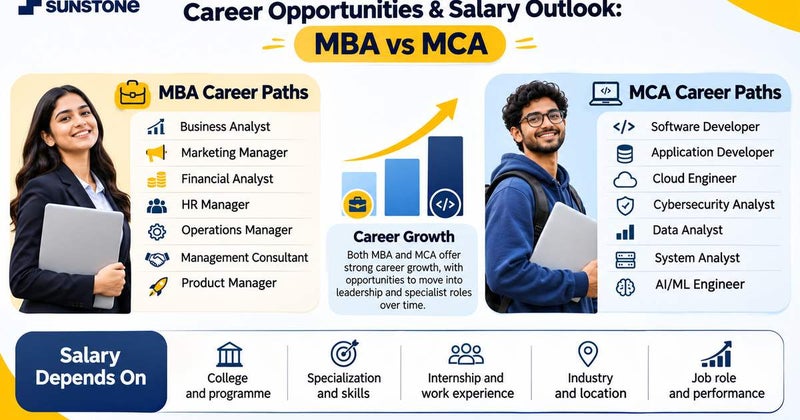
MBA vs MCA: Which Is Better for Salary?
Neither MBA nor MCA guarantees a higher salary. MBA salaries can be influenced by the business school, specialisation, recruiter, role and candidate performance. MCA salaries depend on technical ability, projects, programming skills, employer, role and experience.
MBA graduates may enter business, finance, marketing, consulting, operations or analytics roles. MCA graduates may enter software development, application development, IT support, testing, system analysis or other technical roles.
Approximate Salary After MBA vs MCA in India
As a broad market estimate, fresh graduates may start in the ranges below. These figures are indicative annual Cost to Company (CTC), not guaranteed take-home salaries. Actual offers vary by institute, recruiter, role, location, skills, internships and prior experience.
| College / career stage | MBA (approx. CTC) | MCA (approx. CTC) |
|---|---|---|
| Entry-level / typical fresher opportunities | ₹3–7 LPA | ₹3–8 LPA |
| Stronger colleges and candidates with relevant skills | ₹8–15 LPA | ₹6–12 LPA |
| Top-tier institutions / highly competitive placements | ₹15–30 LPA or higher | ₹12 LPA or higher in selected roles and profiles |
| Experienced professionals | ₹15–20 LPA or higher, depending on role and experience | ₹10–20 LPA or higher, depending on technical skills and experience |
For context, published salary guides commonly place entry-level MBA and MCA outcomes in the mid-single-digit LPA range, while placement reports from leading institutions can show substantially higher averages. A top-college placement figure should not be treated as the expected salary for every graduate.
Salary Factors After MBA
MBA salary outcomes can vary based on:
- Business school reputation and placement opportunities
- MBA specialisation
- Internship experience
- Communication and analytical skills
- Industry and job role
- Recruiter and location
- Prior work experience
For example, an MBA graduate joining a consulting or finance role may have a different compensation structure from someone joining sales, HR or operations.
Salary Factors After MCA
MCA salary outcomes can vary based on:
- Programming and technical skills
- Software projects and portfolio
- Specialisation
- Internship or work experience
- Coding and technical interview performance
- Employer and job location
- Role and technology stack
An MCA graduate with strong development skills may qualify for different opportunities than a graduate whose technical knowledge is mostly theoretical.
For salary-related research, you can also explore Sunstone's guides on MCA salary, jobs and scope in India and software engineer salary in India.
Note: The salary ranges above are indicative market estimates compiled from published salary guides and placement information. They are not guaranteed outcomes or a substitute for a specific college’s latest audited placement report.
Verdict: Do not choose MBA or MCA only because of a salary figure shown in a college advertisement. Compare realistic outcomes for the colleges you are considering, the jobs they recruit for, and the skills you will need to qualify for those roles.
MBA vs MCA: Job Opportunities and Career Scope
MBA and MCA graduates usually enter different job families, although some careers overlap.
Career Options After MBA
MBA graduates can explore careers across business functions, depending on their specialisation and skills.
| Job role | What the work involves |
|---|---|
| Business Analyst | Analysing business processes, data and requirements |
| Marketing Executive/Manager | Campaigns, customer growth, branding and marketing strategy |
| Financial Analyst | Financial reports, analysis, budgeting and planning |
| HR Professional | Recruitment, employee relations and people processes |
| Operations Professional | Process improvement, delivery and operational planning |
| Management Consultant | Helping organisations solve business problems |
| Product Manager | Coordinating customer needs, product priorities and teams |
An MBA can provide opportunities in sectors such as banking, consulting, retail, FMCG, e-commerce, technology, healthcare and startups.
Career Options After MCA
MCA graduates can explore technical and IT-oriented career paths based on their capabilities.
| Job role | What the work involves |
|---|---|
| Software Developer | Writing, testing and maintaining software |
| Web Developer | Building and maintaining websites and web applications |
| Application Developer | Developing software applications |
| System Analyst | Evaluating systems and technical requirements |
| Database Professional | Managing, querying and maintaining databases |
| Cloud-related Roles | Working with cloud platforms and infrastructure |
| Data-related Roles | Analysing, processing or managing data |
MCA graduates may work in IT services, software companies, product organisations, fintech, startups, analytics teams and other technology-driven businesses.
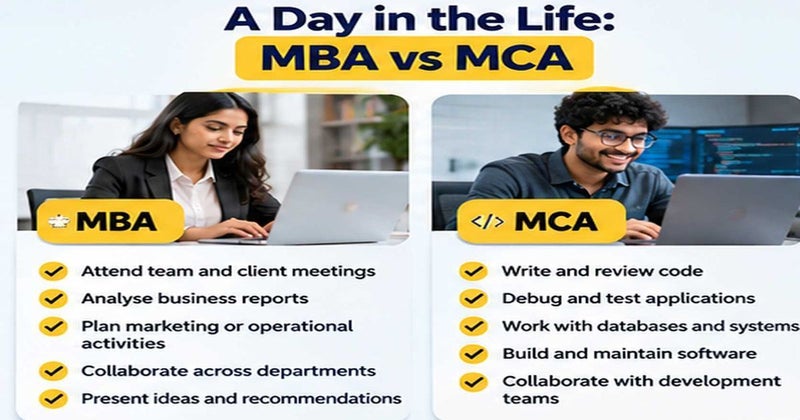
What Does Your Daily Work Look Like After MBA vs MCA?
Job titles can sound attractive, but understanding daily responsibilities can help you make a better course decision.
A Typical Day in an MBA-Related Job
Depending on the role, an MBA graduate may:
- Review business reports and performance metrics
- Prepare presentations and recommendations
- Participate in meetings with clients or teams
- Analyse customer, sales or financial data
- Coordinate projects and stakeholders
- Plan campaigns, operations or business activities
- Help solve business problems
MBA-related work often involves communication, collaboration, analysis, planning and decision-making. The amount of each depends on the function.
A Typical Day in an MCA-Related Job
Depending on the technical role, an MCA graduate may:
- Write and review code
- Debug software or applications
- Test features and fix issues
- Work with databases
- Build or maintain applications
- Collaborate with designers, developers and product teams
- Learn and apply new technical tools
MCA-related work often involves technical problem-solving, building, testing and improving systems. Some roles require extensive coding, while others focus on testing, analysis, databases, infrastructure or support.
The key difference: MBA careers often focus on improving business performance and coordinating people or resources. MCA careers often focus on developing, maintaining or improving technology and systems.
MBA vs MCA: Which Is Easier or More Difficult?
MBA and MCA can both be challenging, but they test different strengths. MBA may feel easier to someone who enjoys communication, business analysis and teamwork. MCA may feel easier to someone who enjoys mathematics, coding and technical problem-solving.
Is MBA Difficult?
MBA coursework can involve:
- Case-study analysis
- Business presentations
- Group assignments
- Quantitative analysis
- Financial concepts
- Research and reports
- Team projects and deadlines
Students who are uncomfortable with public speaking, teamwork or business-related quantitative subjects may need to develop these skills.
Is MCA Difficult?
MCA coursework can involve:
- Programming and coding practice
- Mathematics and logical reasoning
- Data structures and algorithms
- Technical assignments
- Software projects
- Debugging
- Learning new tools and technologies
Students who have little coding experience may need additional practice, particularly in the beginning.
Which is easier? The course that aligns with your strengths may feel easier. Neither MBA nor MCA is automatically easy, and your experience depends on your academic background, curriculum, learning habits and interest.
MBA vs MCA: Which Is Better After BCA, BSc, BCom or BTech?
Your undergraduate degree can influence which postgraduate programme is more relevant. However, your career goal should matter more than simply continuing in the same academic stream.
MBA vs MCA After BCA
After BCA, MCA may be a natural choice if you want to strengthen your computer science and software development knowledge. It can help you build deeper technical expertise and prepare for more specialized IT roles.
MBA may be a better option if you want to move toward business analysis, marketing, consulting, management, product-related roles or entrepreneurship.
| Choose MCA after BCA if… | Choose MBA after BCA if… |
|---|---|
| You enjoy coding | You prefer business problem-solving |
| You want technical depth | You want management knowledge |
| You want software or IT roles | You want business or management roles |
| You want to improve your technical portfolio | You want to develop business, leadership and communication skills |
MBA vs MCA After BSc
Your BSc specialisation matters. A BSc in Computer Science, IT, Mathematics or a related field may provide a foundation for MCA, subject to the university's eligibility requirements.
MBA may suit BSc graduates who want to enter business functions such as finance, marketing, operations, analytics, consulting or management.
If your BSc is unrelated to computer science, check MCA eligibility carefully before applying.
MBA vs MCA After BCom
MBA is often a relevant option after BCom if you want to build a career in finance, marketing, HR, operations, analytics or business management.
MCA may be an option for BCom graduates who meet the programme's academic requirements and want to transition into technology. However, the transition may require additional preparation in programming, mathematics and technical fundamentals.
MBA vs MCA After BTech
After BTech, MBA may suit students who want to move from engineering into business, consulting, product management, operations or leadership-oriented roles.
MCA may be worth considering if a specific programme offers technical learning that aligns with your goals. However, BTech graduates should compare the MCA curriculum against their existing engineering education to determine whether it adds enough value.
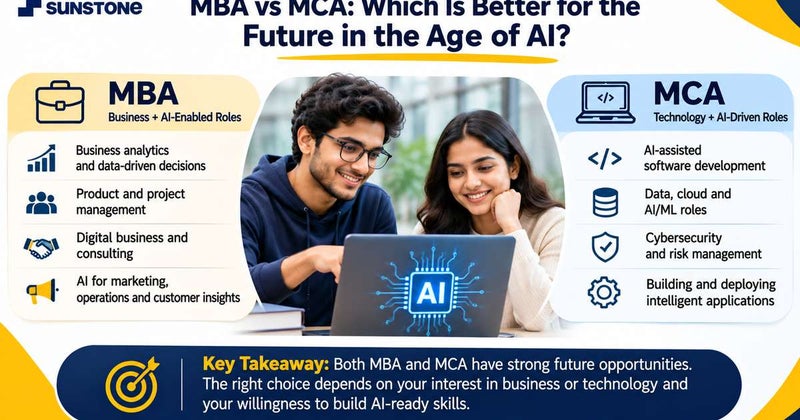
MBA vs MCA: Which Is Better for the Future in the Age of AI?
MBA and MCA careers are both being influenced by artificial intelligence. AI tools can automate parts of business analysis, content creation, reporting, coding, testing and data processing. However, many roles also require judgment, domain knowledge, communication, accountability and problem-solving.
How AI Is Changing MBA Careers
AI tools can help business professionals with:
- Analysing information and summarising reports
- Market and customer research
- Forecasting and data interpretation
- Automating repetitive tasks
- Drafting presentations and business documents
- Supporting decision-making
MBA graduates will still need to understand customers, business models, finance, strategy and the limits of AI-generated information.
How AI Is Changing MCA Careers
AI tools can support technical professionals with:
- Code generation and explanation
- Debugging assistance
- Software testing
- Documentation
- Data analysis
- Prototyping
MCA graduates will need to understand programming fundamentals, system design, security, testing and how to verify AI-generated code. Using AI tools without understanding the underlying technology can create errors and security risks.
Which is better for the future? Neither degree has a guaranteed advantage. MBA graduates who combine business knowledge with analytics and AI literacy can adapt to changing business roles. MCA graduates who combine programming fundamentals with practical projects and emerging technologies can adapt to changing technical roles.
The future value of either degree depends on how well you keep learning beyond the classroom.
MBA vs MCA: What Skills Do Employers Expect Beyond the Degree?
A postgraduate qualification may help you qualify for certain roles, but employers also evaluate practical abilities. Building relevant skills during the course can improve your readiness for interviews and workplace responsibilities.
Skills That Improve MBA Employability
- Communication and presentation skills
- Business analysis
- Excel and data interpretation
- Problem-solving
- Teamwork
- Industry awareness
- Internship experience
- Specialisation-related knowledge
MBA students can build these skills through case studies, projects, internships, competitions and industry assignments.
Skills That Improve MCA Employability
- Programming fundamentals
- Data structures and algorithms
- Database management
- Software development
- Testing and debugging
- Technical problem-solving
- Practical project experience
- Technical communication
MCA students can develop these skills through coding practice, personal projects, internships, open-source contributions and technical interview preparation.
A degree is the starting point. Your ability to apply what you learn is what makes your profile more competitive.
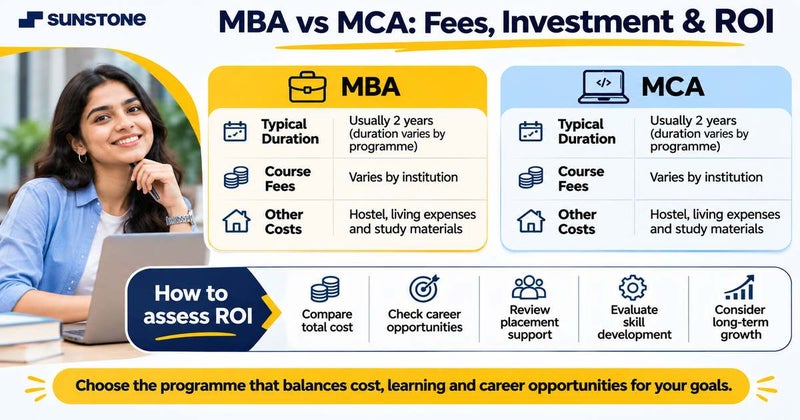
MBA vs MCA: Fees, Investment and Return on Investment (ROI)
The cost of an MBA or MCA includes more than tuition fees. Students should consider the full cost of studying and compare it with realistic career opportunities.
| Cost factor | MBA | MCA |
|---|---|---|
| Approximate total tuition fees | Government: ₹50,000–8 lakh; private: ₹4–25 lakh; premier institutions: ₹17–30 lakh or higher | Government: ₹50,000–3.5 lakh; private: ₹1.5–8.5 lakh; specialised programmes may exceed ₹10–20 lakh |
| Living expenses | Depends on location and campus | Depends on location and campus |
| Study materials | Books, case resources, software and tools | Books, software, hardware and tools |
| Opportunity cost | Income not earned while studying, if applicable | Income not earned while studying, if applicable |
| Internship costs | Travel, relocation or other expenses | Travel, relocation or other expenses |
| ROI factors | College, specialisation, role, network and career progression | College, skills, projects, role and career progression |
Approximate MBA and MCA Fees in India
Course fees differ significantly by institution, location, programme format and facilities. The following ranges are broad estimates for the full programme and should be used for initial comparison. Always confirm the latest fee structure directly with the college.
| Institution category | MBA total tuition fee | MCA total tuition fee |
|---|---|---|
| Government colleges / universities | ₹50,000–8 lakh | ₹50,000–3.5 lakh |
| Private colleges / universities | ₹4–25 lakh | ₹1.5–8.5 lakh |
| Premier / higher-fee institutions | ₹17–30 lakh or higher | Specialised programmes may exceed ₹10–20 lakh |
Important: These are indicative tuition-fee ranges, not fixed or official fee quotations. Hostel, mess, transport, examination, admission, deposits and other charges may be additional. Fees also vary by campus and academic year.
How to Evaluate ROI Before Choosing MBA or MCA
Before paying for a programme, compare:
- Total course cost: Include tuition, accommodation, travel, materials and other charges.
- Career outcomes: Look at the roles graduates actually obtain, not only the highest package.
- Placement information: Review placement participation, median salary where available, recruiters and job profiles.
- Skill development: Determine whether the curriculum provides practical training and relevant projects.
- Your career goal: Evaluate whether the programme helps you qualify for the role you want.
You can explore Sunstone's MBA fees and admission cost information to understand the cost factors involved in management education.
A higher fee does not automatically mean a better return. Similarly, a lower fee does not automatically mean a better investment. Compare the quality of education, available opportunities and realistic outcomes.
Can You Switch Careers After MBA or MCA?
Yes, career transitions are possible after either degree. However, switching careers may require additional skills, experience, certifications, projects or a suitable entry-level opportunity.
Can an MCA Graduate Move Into Management?
An MCA graduate can move toward business-facing or leadership roles over time. Possible paths include:
- Product management
- Project management
- Business analysis
- IT consulting
- Technical team leadership
- Technology operations
Technical experience can be useful in roles that require understanding software, working with engineering teams or evaluating technology-related decisions. Business skills, communication and project experience may help support the transition.
Can an MBA Graduate Move Into Technology?
MBA graduates can pursue business-facing technology careers, such as:
- Product management
- Technology consulting
- IT business analysis
- Digital transformation
- Technology sales
- Business operations in technology companies
However, moving into core software development usually requires coding ability, technical projects and the skills expected by engineering employers.
If you want to become a product manager, understanding both business needs and technology can be useful. You can explore Sunstone's guide on how to become a product manager.
MBA vs MCA: Which Course Offers Better Career Flexibility?
MBA offers flexibility across business functions and industries. MCA offers flexibility across technical roles and technology-driven industries. Neither degree automatically provides unlimited career options.
| Flexibility factor | MBA | MCA |
|---|---|---|
| Industry movement | Business functions across many sectors | Technology-focused sectors and IT roles, with broader options based on skills |
| Role movement | Finance, marketing, HR, operations, analytics and consulting | Development, testing, databases, systems, data and other technical paths |
| Transferable skills | Communication, business analysis, management and decision-making | Programming, technical analysis, problem-solving and system knowledge |
| Career transitions | Business functions and business-facing technology roles | Technical specialization and potential transitions into product or leadership |
| Further development | Specialisations, certifications, experience | Technical certifications, projects, experience and specialisations |
If you want to move between industries while staying in business-oriented roles, an MBA may offer a relevant foundation. If you want to deepen your technology skills and explore different technical roles, MCA may be more suitable.
Who Should Choose an MBA?
An MBA may be a good choice if you:
- Enjoy business, markets and organisational problems.
- Want to work in finance, marketing, HR, operations or consulting.
- Prefer communication, presentations, analysis and teamwork.
- Want to develop management or leadership skills.
- Are interested in entrepreneurship or managing a business.
- Want to move from a technical background toward business-oriented roles.
MBA is not only for students who want to become managers immediately. Many graduates start in analyst, associate, trainee or executive positions and build experience before progressing.
Who Should Choose an MCA?
An MCA may be a good choice if you:
- Enjoy programming and technical problem-solving.
- Want to work in software or IT.
- Like building applications and working with computer systems.
- Want to develop technical expertise.
- Are interested in databases, software engineering, cloud, AI or cybersecurity.
- Meet the eligibility requirements of the MCA programmes you are considering.
MCA is a postgraduate degree, but students should build practical technical skills alongside academic knowledge to prepare for employment.
MBA vs MCA: How to Make the Right Choice
If you are still unsure, use this decision framework to compare your interests and career goals.
| Ask yourself | If your answer is yes, consider |
|---|---|
| Do I enjoy coding and technical problem-solving? | MCA |
| Do I enjoy business strategy and management? | MBA |
| Do I want to build software or applications? | MCA |
| Do I want to work in finance, marketing or operations? | MBA |
| Am I interested in databases, systems and technology? | MCA |
| Do I enjoy presentations, teamwork and business decisions? | MBA |
| Do I want a career in technical IT roles? | MCA |
| Do I want a business-oriented career across industries? | MBA |
Final decision
Choose MBA if you want to develop business, management, communication and leadership skills for business-oriented careers.
Choose MCA if you want to develop computer applications, programming and technical skills for IT and software-oriented careers.
If you are interested in both business and technology, start by identifying your preferred first job. A degree should help you build the skills and knowledge required for that role—not just sound impressive on your resume.
Frequently Asked Questions
Which is better, MBA or MCA?
MBA is better for students who want careers in business, management, finance, marketing, operations or consulting. MCA is better for students who want careers in software development, IT, computer applications and technical roles. The right choice depends on your interests and career goals.
Which is easier, MBA or MCA?
MBA may be easier for students who enjoy business concepts, communication, presentations and teamwork. MCA may be easier for students who enjoy coding, logic, mathematics and technology. Difficulty depends on your strengths and previous academic background.
Which offers a higher salary, MBA or MCA?
Neither degree consistently offers a higher salary for every graduate. As a broad estimate, entry-level MBA graduates may earn around ₹3–7 LPA, while MCA graduates may earn around ₹3–8 LPA. Graduates from stronger institutions or with in-demand skills may earn more. Actual CTC depends on the college, role, recruiter, location, skills and experience, so compare verified placement data for the colleges you are considering.
Which is better after BCA, MBA or MCA?
MCA may be better after BCA if you want deeper technical knowledge and software or IT careers. MBA may be better if you want to move toward business, marketing, finance, consulting, analytics, product or management roles.
Which is better for the future, MBA or MCA?
Both can offer future opportunities. MBA graduates need business knowledge, analytical ability and AI literacy. MCA graduates need strong technical fundamentals, practical projects and the ability to adapt to new technologies. Your ongoing skill development matters more than the degree title alone.
Which has more job opportunities, MBA or MCA?
MBA and MCA lead to different job markets. MBA opportunities span business functions such as finance, marketing, operations, HR and consulting. MCA opportunities are more concentrated in IT, software, application development, data and technical functions. The number of opportunities available to you depends on your skills, college, location and hiring demand.
Can an MCA graduate pursue an MBA later?
Yes. An MCA graduate can pursue an MBA later if they meet the eligibility criteria of the management programme. This can be useful for professionals who want to transition from technical work into business, product, consulting or management roles.
Can an MBA graduate work in the IT industry?
Yes. MBA graduates can work in technology companies in roles such as product management, business analysis, consulting, operations, technology sales and business development. Core technical roles generally require relevant technical skills.
Is MCA good for students who want to become software developers?
MCA can be a suitable postgraduate degree for students who want to pursue software development, provided they build programming fundamentals, work on practical projects, develop problem-solving skills and prepare for technical interviews.
Is MBA worth pursuing without work experience?
Yes, some MBA programmes accept fresh graduates, while others may value or require work experience. The value of an MBA without experience depends on the institution, curriculum, internships, career support and the student's career goals. Check the eligibility and selection requirements of each programme before applying.
Conclusion
MBA and MCA are designed for different career directions. MBA focuses on business, management, strategy and leadership, while MCA focuses on software, computer applications and technical expertise.
If you enjoy business problems, working with people, markets and organisational decisions, an MBA may be the better fit. If you enjoy coding, technology, building applications and solving technical problems, MCA may be more suitable.
Before choosing, compare your interests, undergraduate background, eligibility, total course cost, practical learning opportunities and realistic career outcomes. The best degree is the one that aligns with the work you want to do and helps you build the skills required to succeed in it.
HELP
Take the first step towards your dream job.
ABOUT THE AUTHOR